
Karma, Punishment, Suppression, and the Wrong Target
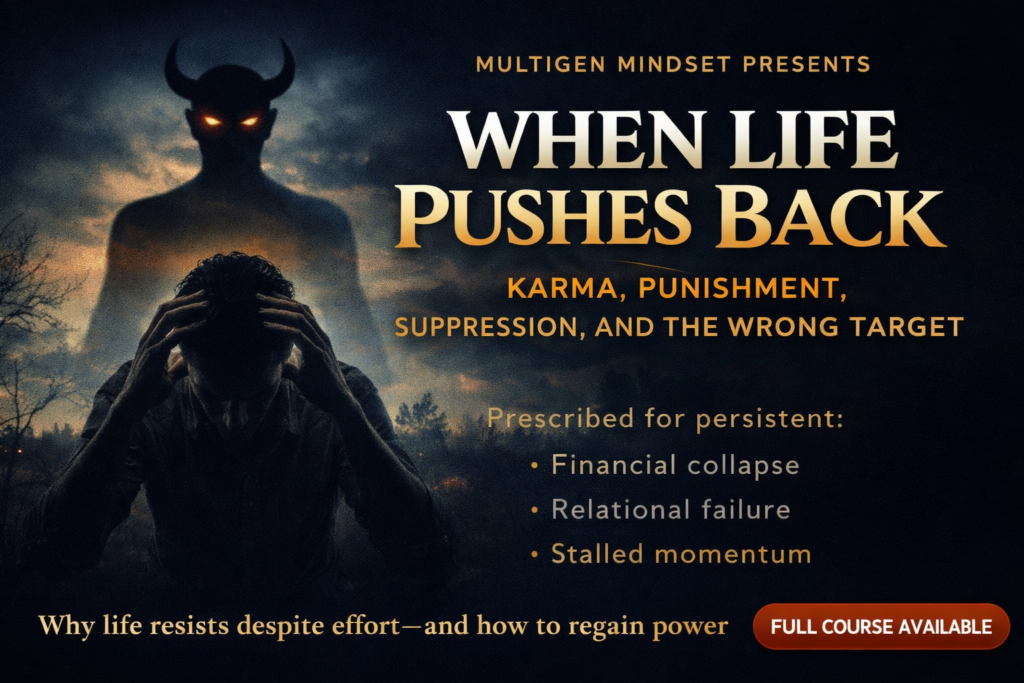
This course is prescribed for students experiencing persistent loss, stalled progress, or repeated collapse despite effort. It is not a comfort course. It is a diagnostic and corrective framework designed to restore sovereignty, alignment, and forward motion.
Most people misunderstand suffering.
They assume pain is random.
They assume loss is punishment.
They assume resistance means they are cursed, unlucky, or spiritually flawed.
They are wrong.
What most people experience as “life pushing back” is not punishment—it is exposure. And exposure is information.
This article exists to introduce a framework most people are never taught:
How to correctly diagnose karma, misalignment, suppression, and wrong targeting—and why confusing them keeps intelligent, capable people stuck for years.
The Problem of Persistent Loss
There is a specific type of suffering this course is designed for.
Not a single bad year.
Not one failed relationship.
Not a temporary financial hit.
But patterns:
- Repeated financial collapse despite effort
- Relationships that consistently drain power
- Businesses that stall just before momentum
- A sense of being “blocked,” watched, or constrained
- The feeling that effort no longer produces proportional results
When conditions persist, time is no longer the variable. Diagnosis is.
And yet, under pressure, the human mind instinctively searches for something to blame.
God.
Karma.
Demons.
Parents.
Ex-partners.
The economy.
The self.
This instinct—to find a culprit—is natural.
But it is also where most people lose power.
Before you ask who is responsible, you must ask a more dangerous question:
“What is actually happening here?”
What Karma Actually Is (and Is Not)
In modern culture, karma has been reduced to a spiritual threat:
“Something bad is happening because I did something bad.”
This is not how karma functions in any serious tradition.
Across Hinduism, Buddhism, Judaism (“measure for measure”), Christianity (“you reap what you sow”), Islam, and Hermetic law—karma is not emotional, vengeful, or immediate.
Karma is law. Not judgment.
It is delayed, cumulative, and often misattributed.
Most people mistake:
- Coincidence for karma
- Pressure for punishment
- Exposure for attack
True karmic consequence usually shows up after patterns, not single actions—and often only once the individual has enough awareness to correct it.
Which leads to the distinction almost everyone misses.
Punishment vs Exposure
Punishment implies judgment.
Exposure implies misalignment.
When you are out of alignment with truth, responsibility, or structure, protection is reduced—not because you are hated, but because systems do not support disorder.
This is why exposure feels like attack.
It feels personal.
It feels targeted.
It feels unfair.
But exposure simply reveals what was already unstable.
Nothing is being taken from you.
Something is being shown to you.
The Story of Job: When Suffering Is Not Bad Decisions
Job is one of the most misread spiritual texts in history.
Job is righteous. Disciplined. Ordered.
And yet everything collapses.
Why?
Not because Job is evil.
Not because God is cruel.
But because misalignment creates access points.
“Satan” in the story is not a cartoon villain—it is the accuser. The force that exposes weakness once permission exists.
Job’s friends get it wrong by blaming him.
Job gets it wrong by defending himself emotionally.
The correct reading is this:
Righteous people can still be exposed.
And suffering is not always the result of poor decisions—sometimes it is the result of unexamined assumptions.
Internal Darkness vs External Pressure
Ancient systems—from the Tablets of Thoth to early diagnostic philosophies—asked one core question:
“Is this coming from within me, or from outside of me?”
Internal sources:
- Subconscious beliefs
- Identity collapse
- Shame loops
- Negative expectation
External sources:
- Suppressive relationships
- Envy
- Relational pressure
- Strategic opposition
Confusing these is fatal.
If you treat internal misalignment as external attack, you become paranoid.
If you treat external suppression as internal flaw, you become weak.
Most people never escape because they are fighting the wrong battle.
The Principle of the Wrong Target
Under stress, humans require a target.
But pressure does not guarantee accuracy.
Common wrong targets:
- God
- Karma
- Parents
- Former partners
- “The system”
When you aim at the wrong target, power bleeds out of you.
Correct targeting restores sovereignty instantly—not because the problem disappears, but because authority returns.
Power does not come from effort alone.
It comes from correct orientation.
Why Conditions Persist
Situations do not repeat because you are unlucky.
They repeat because the lesson was not integrated.
Time does not heal misalignment.
Insight does.
When alignment is not restored:
- Pressure increases
- Stakes rise
- Loss compounds
This is not cruelty.
It is escalation designed to force awareness.
Suppression Through Relationships
Some of the most dangerous suppression is not violent—it is relational.
When someone benefits from your limitation, growth becomes a threat.
“You’re changing.”
“You think you’re better now.”
“If you grow, you’ll leave me.”
Love without alignment becomes bondage.
Power is not stolen—it is handed away slowly through fear-based attachment.
Compound Suppression
This is the stage where most people break.
- Unresolved karma
- Misaligned relationships
- Resistance to correction
- Identity erosion
Effort fails here because effort alone cannot correct orientation.
This is where people feel “pinned down.”
And this is where diagnosis—not motivation—is required.
The Final Reframe
Nothing is against you.
But something is being revealed.
- Loss is information
- Pressure is diagnosis
- Suffering is exposure
Blame is the final trap.
Clarity restores momentum because clarity restores authority.
Who This Course Is Prescribed For
This course is not for casual curiosity.
It is prescribed for individuals experiencing:
- Repeated financial collapse
- Persistent relational failure
- Loss of authority or motivation
- A sense of being blocked or diminished
- Leaders who feel their power slipping
- Those tempted to blame God, karma, or fate
If life feels like it is pushing back, this course does not comfort you.
It reorients you.
Final Note
This article introduces the framework.
The course provides the full diagnostic system, corrective tools, and re-alignment process.
Some people want relief.
Others want truth.
This course is for the second group.